
In the fiercely competitive realm of digital marketing, having the right tools is paramount for SEO success. For anyone serious about improving their search engine rankings, the debate often boils down to three titans: Ahrefs, Semrush, and Moz. Each platform offers a robust suite of features designed to empower marketers, but they also have distinct strengths and weaknesses. This comprehensive guide will meticulously compare Ahrefs vs Semrush vs Moz, helping you make an informed decision about which SEO software best fits your needs.
Whether you're a seasoned SEO professional, a small business owner, or a content creator, understanding the nuances of these platforms is crucial. We'll dive deep into their core functionalities, pricing structures, unique selling propositions, and ideal use cases to arm you with all the information you need.
Understanding the Contenders: Ahrefs, Semrush, and Moz
Before we pit them against each other, let's briefly introduce our contenders. These platforms are not just simple keyword research tools; they are comprehensive SEO ecosystems.
Ahrefs: The Backlink Powerhouse
Ahrefs is widely revered for its unparalleled backlink data. Launched in 2010, it quickly gained a reputation for having the largest and freshest index of backlinks, making it an indispensable tool for link building and competitor analysis. While it has expanded significantly into other areas like keyword research and site auditing, its roots as a backlink giant remain a core identity.
Semrush: The All-in-One Marketing Suite
Semrush, founded in 2008, has evolved into a true all-in-one digital marketing platform. Beyond its strong SEO capabilities, it offers extensive tools for PPC, social media marketing, content marketing, and competitive intelligence. Its broad appeal makes it a favorite for agencies and businesses looking for a single solution across multiple marketing channels.
Moz: The Authority on SEO Metrics
Moz, established in 2004, is one of the oldest and most respected names in the SEO industry. Known for pioneering metrics like Domain Authority (DA) and Page Authority (PA), Moz has built a reputation for its user-friendly interface, educational resources, and strong community. It provides comprehensive tools for keyword research, link building, site audits, and local SEO.
Feature Showdown: Diving Deep into Ahrefs vs Semrush vs Moz
Let's break down the most critical SEO functionalities and see how each tool performs.
1. Keyword Research
Keyword research is the foundation of any successful SEO strategy. All three tools offer robust features, but with different approaches.
- Ahrefs: Its Keyword Explorer is excellent for finding keyword ideas, analyzing search volume, keyword difficulty, and SERP overview. It excels at showing 'parent topic' for keywords, helping you group related terms efficiently. It also provides a vast database of keywords for various search engines beyond Google.
- Semrush: The Keyword Magic Tool is incredibly powerful, offering millions of keyword suggestions, detailed metrics (volume, difficulty, CPC), and intent filters. Its "Keyword Gap" tool is fantastic for uncovering keywords your competitors rank for but you don't.
- Moz: Moz Keyword Explorer provides accurate search volume estimates, keyword difficulty, and organic CTR data. Its "Priority Score" helps you prioritize keywords based on difficulty, volume, and your site's authority.
2. Backlink Analysis
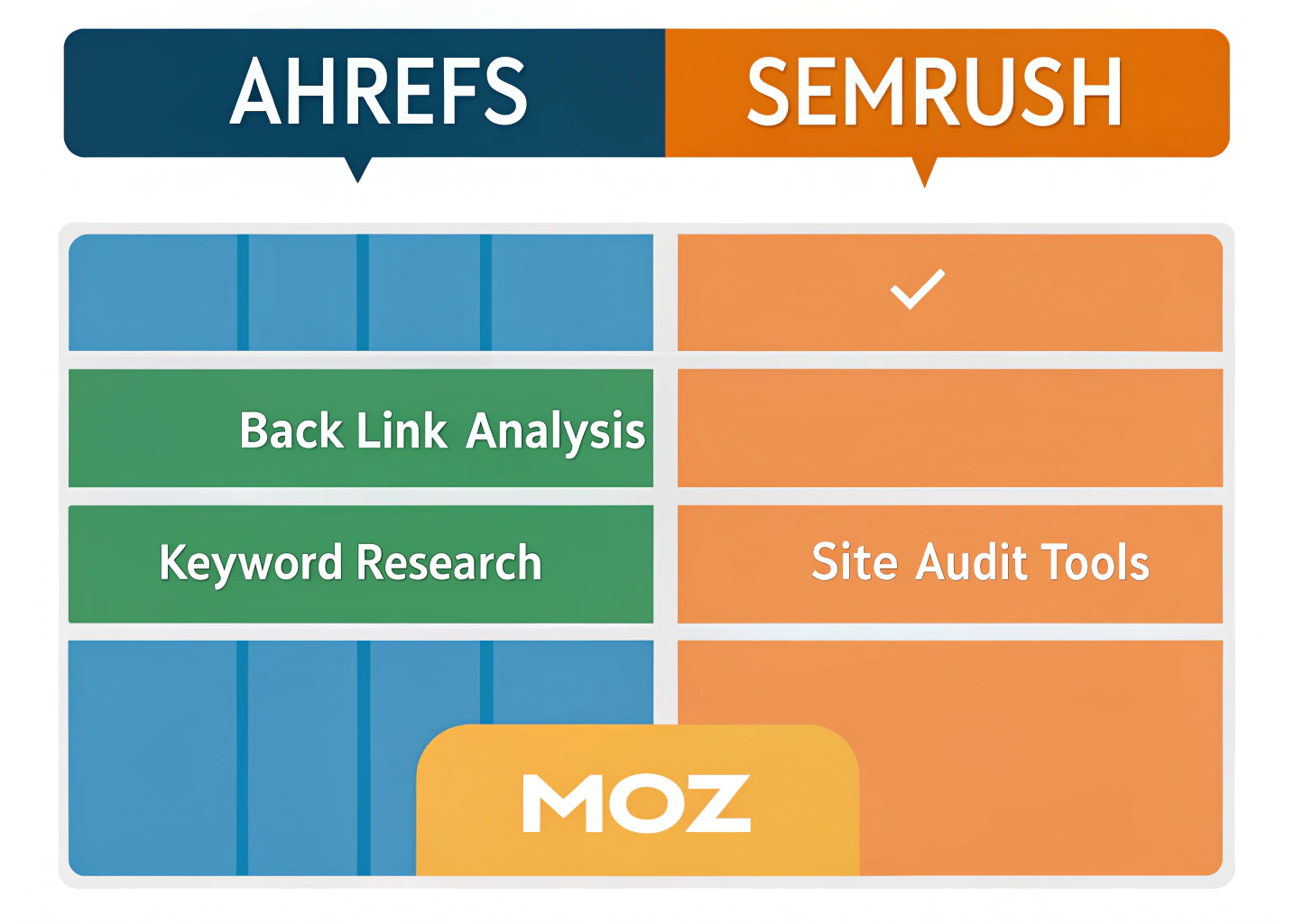
Backlinks are a crucial ranking factor, and this is where Ahrefs traditionally shines.
- Ahrefs: Undisputedly the king of backlink data. Its Site Explorer offers the largest live backlink index, showing referring domains, anchor text, new/lost backlinks, and a comprehensive breakdown of link profiles. It's ideal for deep link audits and competitor backlink analysis.
- Semrush: Offers a strong Backlink Analytics tool with a large database, competitive with Ahrefs in many aspects. It provides metrics like Authority Score, referring domains, and toxic backlink identification. Its Link Building Tool also streamlines outreach.
- Moz: Link Explorer is known for its Domain Authority and Page Authority metrics, which have become industry standards. It provides a good overview of link profiles, anchor text, and spam score, though its link index size is generally considered smaller than Ahrefs and Semrush.
3. Site Audits & Technical SEO
Identifying and fixing technical SEO issues is vital for site health.
- Ahrefs: Site Audit is comprehensive, crawling your site to find common SEO issues like broken links, redirect chains, duplicate content, and performance problems. Its visual reports are easy to understand.
- Semrush: The Site Audit tool is incredibly detailed, checking for over 130 technical and SEO issues. It categorizes issues by severity, offers clear explanations, and provides actionable recommendations. It also integrates with Google Search Console for even deeper insights.
- Moz: Moz Pro's Site Crawl identifies critical issues, warnings, and opportunities. It's user-friendly and provides clear guidance on how to fix problems, though perhaps not as granular as Semrush or Ahrefs.
4. Competitor Analysis
Understanding your competitors' strategies is key to outranking them.
- Ahrefs: Site Explorer allows you to see organic keywords, top pages, content gaps, and PPC ads for any competitor. Its "Competing Domains" report helps identify new rivals.
- Semrush: Excels here with tools like Organic Research, Keyword Gap, Backlink Gap, and Advertising Research. You can dissect competitor strategies across organic search, paid search, and even display advertising.
- Moz: Offers robust tools for comparing your site's performance against competitors in terms of keywords, rankings, and link profiles. Its Domain Analysis provides a quick competitive overview.
5. Content Marketing & Research
Creating content that ranks requires smart research.
- Ahrefs: Content Explorer helps you find popular content on any topic, identify content gaps, and analyze link profiles of top-performing articles.
- Semrush: Its Content Marketing Toolkit is a standout feature, offering Topic Research, SEO Content Template, Content Audit, and Post Tracking. It helps you generate ideas, optimize content during creation, and analyze its performance.
- Moz: While not as specialized in content marketing as Semrush, its keyword research and site explorer can inform content strategies by identifying high-volume, low-difficulty keywords and analyzing competitor content.
Pricing & Plans: Which Tool Fits Your Budget?
The cost is often a significant factor in choosing an SEO tool. All three operate on a subscription model with varying tiers.
Ahrefs Pricing
- Lite: Starts at $99/month. Good for small businesses and individual SEOs. Limited projects and crawl credits.
- Standard: $199/month. More projects, more crawl credits, and advanced features.
- Advanced: $399/month. For agencies and larger teams, offering more data and historical metrics.
- Enterprise: $999+/month. Custom solutions for very large organizations.
Ahrefs is known for its "credit" system, which can sometimes be limiting for heavy users on lower plans.
Semrush Pricing
- Pro: Starts at $129.95/month. Ideal for freelancers, startups, and in-house marketers with limited budgets.
- Guru: $249.95/month. For growing agencies and SMBs, including content marketing platform features and historical data.
- Business: $499.95/month. For large agencies and enterprises, offering more limits and advanced features.
Semrush often provides a 7-day free trial, which is excellent for testing its extensive features.
Moz Pricing
- Standard: Starts at $99/month. For individuals and small businesses, includes basic features.
- Medium: $179/month. For consultants and growing businesses, with more campaigns and data.
- Large: $299/month. For larger agencies and in-house teams.
- Premium: $599/month. For enterprises needing extensive data and support.
Moz also offers a 30-day free trial for its Pro plan, which is a significant advantage for thorough evaluation.
Pros and Cons: A Balanced View of Ahrefs vs Semrush vs Moz
Ahrefs
- Pros:
- Unmatched backlink database and analysis.
- Excellent for competitor analysis and content gap identification.
- Powerful Content Explorer for topic research.
- Intuitive user interface for experienced SEOs.
- Cons:
- Higher entry price compared to some competitors.
- Credit system can be restrictive.
- Less focused on PPC or social media features.
- No free trial (only a 7-day trial for $7).
Semrush
- Pros:
- Truly all-in-one digital marketing suite (SEO, PPC, SMM, Content).
- Robust keyword research with the Keyword Magic Tool.
- Comprehensive Site Audit and technical SEO features.
- Excellent for content marketing and competitor intelligence.
- Generous free trial.
- Cons:
- Can be overwhelming for beginners due to the sheer number of features.
- Backlink data, while strong, is sometimes considered slightly less comprehensive than Ahrefs.
- Higher pricing for advanced features and larger data limits.
Moz
- Pros:
- Industry-standard metrics like Domain Authority and Page Authority.
- User-friendly interface, great for beginners.
- Strong focus on education and community.
- Good for local SEO.
- Long 30-day free trial.
- Cons:
- Smaller backlink index compared to Ahrefs and Semrush.
- Keyword research tools can be less granular than competitors.
- Slower data updates in some areas.
- Less comprehensive for non-SEO marketing aspects (PPC, SMM).
Who Should Use Which Tool?
Choose Ahrefs if:
- Your primary focus is backlink analysis and link building.
- You need the most comprehensive and up-to-date backlink data.
- You're an advanced SEO professional or agency heavily involved in off-page SEO.
- You want to conduct deep competitor backlink analysis and content gap analysis.
Choose Semrush if:
- You need an all-in-one digital marketing solution beyond just SEO.
- You manage PPC campaigns, social media, and content marketing alongside SEO.
- You require extensive keyword research capabilities with intent filters.
- You're an agency or a business with diverse marketing needs and want to streamline your toolset.
Choose Moz if:
- You're an SEO beginner or small business owner looking for an intuitive platform.
- You heavily rely on Domain Authority and Page Authority for link prospecting.
- Local SEO is a significant part of your strategy.
- You value strong community support and educational resources.
- You appreciate a longer free trial to thoroughly evaluate the tool.

Making Your Choice: Ahrefs vs Semrush vs Moz
The decision of which SEO tool to invest in ultimately depends on your specific needs, budget, and expertise level. There's no single "best" tool among **Ahrefs vs Semrush vs Moz**; rather, there's the best tool for *you*.
Consider your primary goals: Are you focused purely on technical SEO and link building? Ahrefs might be your champion. Do you need a holistic platform that covers every aspect of digital marketing? Semrush is a strong contender. Are you just starting out, or do you prioritize user-friendliness and established authority metrics? Moz could be your ideal choice.
Many experienced professionals even use a combination of these tools to leverage the unique strengths of each. For instance, using Ahrefs for deep backlink analysis and Semrush for comprehensive keyword research and content marketing can be a powerful strategy.
Before committing, take advantage of the free trials offered by Semrush and Moz, or Ahrefs' paid trial. Test their features with your own website and your competitors' sites. Evaluate the data, ease of use, and how well each tool integrates into your existing workflow.
Conclusion
The debate of Ahrefs vs Semrush vs Moz is a testament to the quality and depth these platforms bring to the SEO landscape. Each tool offers a powerful arsenal for optimizing your online presence, driving organic traffic, and outranking competitors. By carefully considering your specific requirements, budget, and skill level, you can confidently select the SEO software that will propel your digital marketing efforts forward.
Invest wisely, master your chosen tool, and watch your SEO performance soar!
Frequently Asked Questions (FAQ)
Q1: Which tool is best for beginners: Ahrefs vs Semrush vs Moz?
A: Moz is often recommended for beginners due to its user-friendly interface, clear explanations of SEO concepts, and its strong educational resources. Semrush also offers good onboarding, but its vast array of features can sometimes feel overwhelming to new users.
Q2: Can I use Ahrefs, Semrush, and Moz together?
A: Yes, many advanced SEO professionals and agencies use a combination of these tools. For example, Ahrefs might be used for its superior backlink data, Semrush for its comprehensive keyword research and content marketing suite, and Moz for its Domain Authority metrics and local SEO features. This allows them to leverage the unique strengths of each platform.
Q3: Which tool offers the best value for money: Ahrefs vs Semrush vs Moz?
A: Value for money is subjective and depends on your specific needs. If you need an all-in-one digital marketing solution, Semrush often provides excellent value. If backlink analysis is your absolute priority, Ahrefs offers unmatched depth. Moz provides good value for its core SEO features and user-friendliness, especially for small businesses. It's best to compare their pricing tiers against the features you'll actually use.
Q4: Which tool has the largest keyword database?
A: Semrush generally boasts one of the largest keyword databases, often citing billions of keywords. Ahrefs also has a massive database, particularly strong for global keyword data and different search engines. Moz's database is substantial but typically smaller than the other two giants.
Q5: Is there a free version or free trial for Ahrefs, Semrush, or Moz?
A: Semrush offers a generous 7-day free trial for its Pro and Guru plans. Moz offers a 30-day free trial for its Pro plan. Ahrefs has a 7-day trial for $7, which provides access to most features. Both Semrush and Moz also offer limited free accounts with basic features, but Ahrefs does not have a free account option.